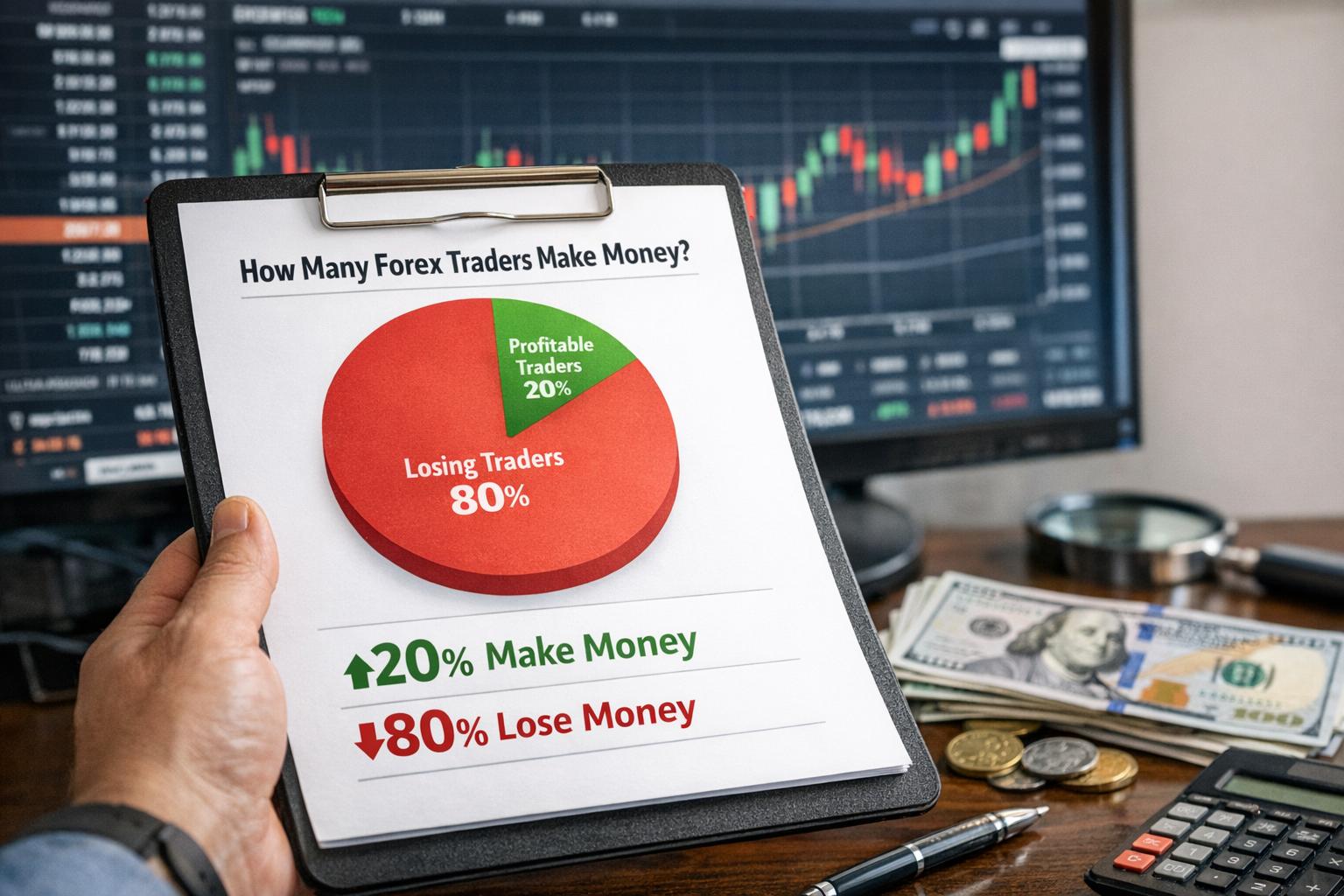
The percentage of forex traders who make money consistently is extremely low, but the exact numbers will vary depending on which studies you look at. In general, around 10–15% of retail forex traders make a profit over the long term. This means that approximately 85–90% of retail forex traders lose money over time.
These figures are frequently cited in regulatory disclosures from brokers operating in jurisdictions such as the European Union and the United Kingdom, where firms are required to publish the percentage of retail client accounts that lose money. While the specific number differs from broker to broker, it is common to see disclosures stating that between 70% and 85% of retail accounts are unprofitable. Over longer periods, the proportion of traders who fail to maintain consistent profitability tends to increase further.
It is important to clarify what “make money consistently” means in this context. A trader may experience short-term gains or even several profitable months, but consistency implies sustained profitability over years while accounting for transaction costs, slippage, and drawdowns. Measuring long-term success requires statistical significance and disciplined tracking of performance, not just occasional winning trades.
Retail forex traders have a low success rate – here are some contributing factors
Below, we will take a closer look at several structural, psychological, and practical factors that contribute to these statistics and help explain why it is relatively unusual for retail forex traders to become profitable over the long term.
High Market Volatility
The forex market is highly liquid and reacts quickly to new information. Exchange rates are influenced by macroeconomic data releases, central bank policy decisions, geopolitical developments, capital flows, and shifts in global risk appetite. Even scheduled economic announcements can lead to sudden price spikes and sharp reversals within seconds.
This volatility creates opportunity. Without price fluctuations, there would be no potential for speculative profit. However, volatility also increases uncertainty. Retail traders may enter positions based on technical setups or short-term patterns, only to experience significant moves caused by unexpected statements from policymakers or unanticipated macroeconomic data.
Professional trading desks often employ sophisticated risk models, automated execution systems, and teams monitoring news events around the clock. Retail traders usually operate with limited tools, less comprehensive information, and smaller capital buffers. As a result, rapid market changes can have a disproportionate impact on their accounts.
Volatility also increases the risk of slippage, where orders are executed at a worse price than expected, especially during fast-moving markets. For traders using tight stop-loss levels, this can significantly affect performance statistics over time.
Psychological Pressures
Many novice retail forex traders begin with day trading. Day trading has certain advantages, including reduced overnight exposure and frequent opportunities, but it requires rapid decision-making and sustained concentration. This environment can increase emotional intensity and lead to inconsistent behavior, particularly among beginners.
Emotional responses such as fear and greed can interfere with rational strategy execution. A trader may exit a winning position too early out of fear of losing unrealized gains. Conversely, a losing position may be held longer than planned in the hope that the market will reverse. Over time, these deviations from a structured plan can undermine performance.
One well-known issue is the temptation to overtrade. Because the forex market operates 24 hours a day during the workweek, opportunities appear continuous. After a loss, a trader may feel compelled to immediately place additional trades to “recover” the loss. This reactive behavior often leads to increased exposure without improved decision quality.
Retail trading is typically a solitary activity. Unlike institutional environments where risk managers and compliance officers may enforce position limits, individual traders must regulate themselves. No external supervisor will instruct them to stop trading when fatigued, emotionally distressed, or unfocused. Self-regulation is therefore a critical component of long-term viability, but it is difficult to maintain consistently.
Discipline involves following predetermined entry and exit criteria, respecting risk limits, and maintaining consistent position sizing. Even traders with technically sound strategies can fail if they repeatedly override their own trading plans.
Lack of Proper Knowledge, Insights, and Strategy
Many retail traders enter the forex market without sufficient preparation. The accessibility of online trading platforms makes it possible to open an account and begin trading quickly, sometimes within minutes. However, ease of access does not imply ease of mastery.
A comprehensive understanding of forex trading requires familiarity with macroeconomic principles, interest rate dynamics, central bank mandates, technical analysis frameworks, risk management methodologies, and statistical probability. Without grounding in these areas, traders may rely on informal sources such as online forums, social media personalities, or unverified “signal” providers.
Strategies adopted without testing can lead to inconsistent results. A robust trading approach typically involves backtesting on historical data, forward testing in simulated environments, and detailed performance tracking. These stages require time and methodical analysis, which many new traders underestimate.
It is also common for traders to shift strategies frequently after short-term drawdowns. Moving from one system to another without allowing statistical probabilities to unfold can prevent the realization of any meaningful edge. Consistency demands patience and data-driven evaluation rather than reaction to short-term fluctuations.
Entering the forex market with expectations of immediate and substantial returns often leads to overexposure and insufficient preparation. Trading should be approached as a skill-based activity that requires sustained effort and realistic performance benchmarks.
High Transaction Costs
All trading involves costs. In forex, these usually take the form of spreads (the difference between bid and ask prices) and, depending on the account type, explicit commissions. While individual transaction costs may appear small, their cumulative effect can be significant, particularly for high-frequency strategies.
Day traders who execute multiple trades per session pay the spread repeatedly. Even a strategy with a slight statistical advantage can become unprofitable after accounting for execution costs. Profitability must therefore exceed the break-even threshold created by these fees.
Beyond spreads and commissions, traders may incur additional expenses such as deposit fees, withdrawal charges, inactivity fees, overnight swap rates, and data feed subscriptions. When leverage is used, financing costs can also accumulate if positions are held beyond a single trading session.
Each monetary unit paid in fees reduces available trading capital. Over time, the compounding impact of such costs can significantly affect net returns. Careful evaluation of broker pricing structures and alignment with trading style is therefore essential.
Leverage
Leverage allows traders to control large positions with comparatively small amounts of capital. Ratios of 50:1, 100:1, or higher are common in certain jurisdictions, and some brokers offer significantly greater multiples where regulations permit. While leverage increases potential returns on successful trades, it equally magnifies losses.
A small percentage move against a highly leveraged position can result in a substantial loss relative to account equity. In extreme cases, accounts may be depleted rapidly. New traders sometimes focus on the amplified profit potential without fully assessing downside risk.
Regulators in several regions, including the European Union, the United Kingdom, and Australia, have implemented leverage caps for retail clients. These measures aim to reduce the probability of rapid losses, particularly among inexperienced traders. Lower leverage requirements for major currency pairs and even stricter limits for minor and exotic pairs reflect differences in volatility and liquidity.
Effective leverage management involves not only selecting a moderate maximum ratio but also limiting position size relative to total account equity. Risk exposure per trade is often measured as a percentage of capital, with more conservative traders restricting this to a small fraction to withstand inevitable drawdowns.
Structural Challenges Facing Retail Traders
In addition to the factors described above, retail traders operate within a market ecosystem where institutional participants possess certain structural advantages. Large financial institutions may benefit from superior technology, lower transaction costs, direct market access, advanced analytics, and dedicated research teams.
This does not imply that retail participants cannot succeed. However, it does mean that competing effectively requires careful selection of niche strategies, disciplined cost control, and realistic expectations about performance variability.
Retail traders often specialize in shorter-term speculation rather than large-scale fundamental positioning. Each approach has distinct advantages and constraints. Understanding the market environment and aligning strategy with available resources are critical components of sustainability.
Common Misconceptions About Forex Profitability
- “Everyone is making money except me”: Social media frequently presents selective examples of profitable trades, high returns, or luxury lifestyles attributed to forex trading. In practice, such representations often omit losses, drawdowns, and the statistical rarity of consistent outperformance. Some examples may stem from marketing efforts rather than independently verified results.
- “Forex is quick and easy to learn”: The basic mechanics of currency exchange can be explained in a short time. However, achieving durable profitability requires understanding macroeconomic cycles, risk allocation, probability distributions, and behavioral finance concepts. Developing these competencies typically takes extended study and real-market experience.
Are There Successful Retail Forex Traders?
Yes, some retail traders do achieve sustained profitability. Their success tends to be associated with several characteristics: disciplined risk management, conservative leverage usage, systematic strategy evaluation, and realistic return expectations.
Successful traders often maintain detailed performance records, reviewing metrics such as win rate, average reward-to-risk ratio, maximum drawdown, and expectancy per trade. These data-driven evaluations allow for incremental adjustments rather than abrupt strategy changes.
They also tend to prioritize capital preservation. Limiting downside volatility enables accounts to remain operational long enough for statistical edges to manifest. Without adequate risk control, even a promising strategy can fail due to a sequence of unfavorable outcomes.
Most consistently profitable retail traders treat forex trading as a structured professional activity rather than a speculative shortcut to wealth. They allocate time for research, maintain disciplined processes, and accept that losses are an inherent component of trading performance.
While the proportion of consistently profitable retail forex traders remains relatively small—often estimated at around 10–15%—the primary distinguishing factor appears to be rigorous risk management combined with sustained discipline. For the majority of participants, the combination of volatility, leverage, psychological pressure, transaction costs, and incomplete preparation presents substantial challenges. Understanding these factors provides a more realistic perspective on what is required to pursue long-term profitability in the forex market.
This article was last updated on: March 28, 2026