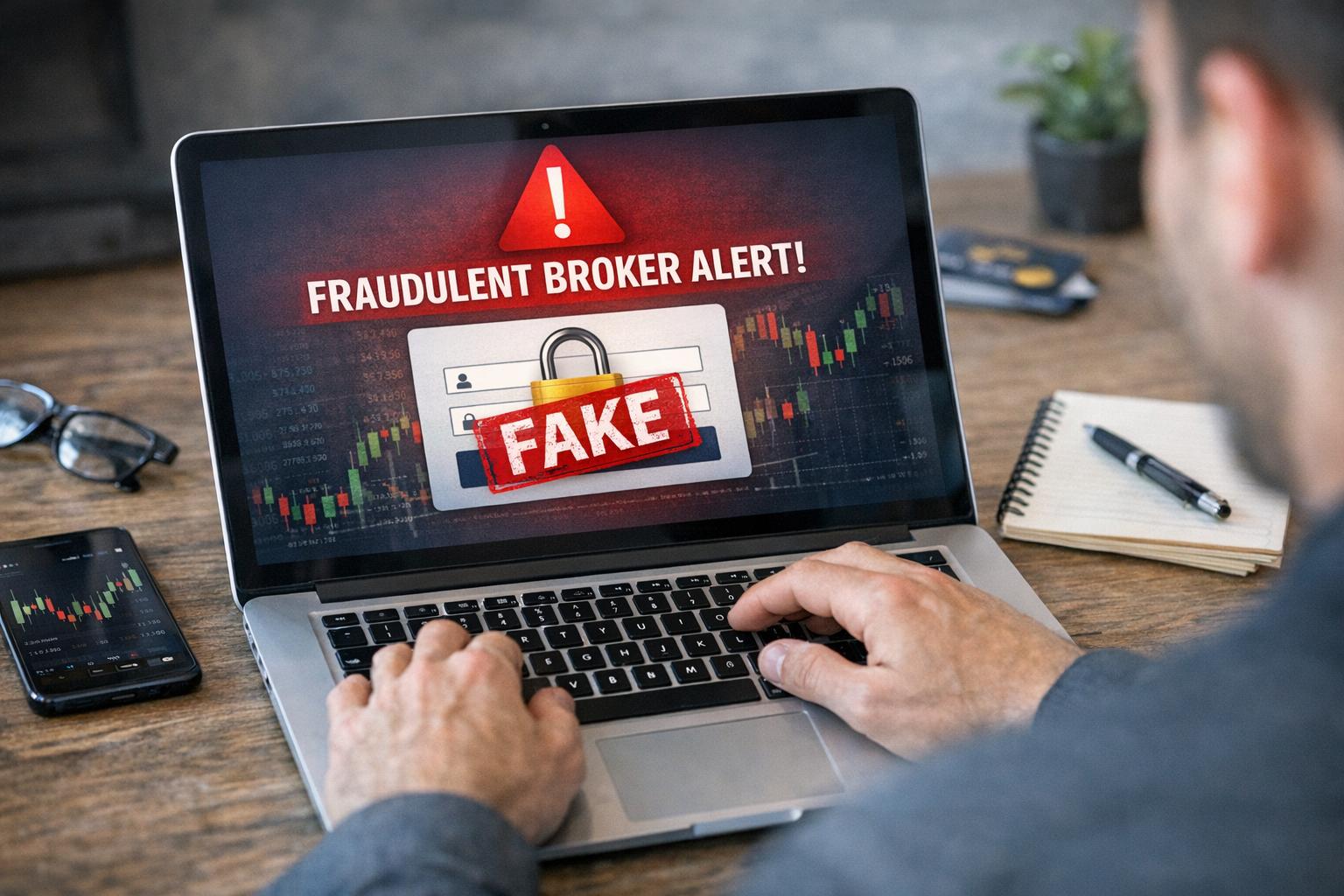
There are many reputable brokers to chose from if you are interested in trading online, but there are unfortunately also fraudsters who pose as brokers to lure in victims. Some of them actually provide a brokerage service but with disreputable practices, while others are only quick scams where the intention is to harvest a number of first deposits and private information from people and then vanish.
Below, we will share a few points that are good to keep in mind when selecting a broker for online trading. There are never any guarantees, but by being well informed and doing your due diligence, you can reduce the risk of falling victim to a broker scam online.
If you encounter something that you find suspicious, you can report it to the relevant financial authority or to the police.
Regulation
It is generally best to pick a broker that is regulated where you live and trade, as this puts you in a better legal situation. This means that a trader in the UK will pick a broker regulated by the FCA, a trader in Australia will use an ASIC regulated broker, a trader in the European Union will select a broker that is based and regulated in one of the membership countries, and so on.
A properly regulated broker is subject to supervision, reporting requirements, and rules regarding client fund protection. In many well-regulated jurisdictions, brokers are required to keep client funds segregated from the company’s operational funds. This reduces the risk that your deposit will be used to cover the broker’s business expenses or debts. Some jurisdictions also require participation in investor compensation schemes, which may provide limited reimbursement if the broker becomes insolvent.
In some cases, this may not be a feasible route. You may be living in a country where there is no proper authority in place that actually regulates, authorizes and oversees online brokers. Or, you live in a country where the financial authority in charge is known to be lax and not really provide much in the way of trader protection. In these situations, many traders will instead pick a broker that is active internationally and licensed by a reputable financial authority that is known to be strict when it comes to trader protection. This solution is not ideal, but may be the “least bad” one in certain situations.
When you have found a broker you are interested in using, always check with the applicable financial authority to find out if this broker is actually licensed by them and if the license is up to date. It is very easy for a scam broker to claim to be licensed by a reputable authority. Fraudulent sites sometimes publish fake license numbers, copy the details of legitimate firms, or create clone websites that appear almost identical to the website of a real broker.
Verification should be done directly through the official website of the regulator. Search the regulator’s online register for the broker’s legal name and license number. Confirm that the website domain you are using matches the one listed in the register. Small spelling differences in domain names are common in scams.
You should also pay attention to any disciplinary history. Many regulators publish warnings, fines, and other enforcement actions. A record of repeated violations or serious misconduct is a warning sign that deserves careful consideration.
Special considerations regarding binary options
If you are a hobby trader who wishes to use binary options, finding a broker regulated by a strict authority will not be easy, because most of the top-tier authorities have banned brokers from offering, selling and marketing binary options to non-professional traders. This means that the brokers that are still offering binary options to non-professional traders (retail traders) tend to be located in lax jurisdictions. This will, of course, increase the risk of ending up with a fraudulent broker. For non-professional traders, it is generally advisable to stay away from binary options altogether. You can for instance look for reputable brokers that offer Contracts for Difference (CFDs) instead, since these derivatives have certain similarities with binary options in terms of allowing speculation on price movements without owning the underlying asset.
Binary options are still legal in the United States, but only if they are traded on a regulated U.S. exchange in accordance with the requirements set by the Commodity Futures Trading Commission (CFTC). At the time of writing, only three exchanges in the U.S. have the necessary designation (Designated Contract Market /DCM) to list binary options.
- Cantor Exchange, LP
- Chicago Mercantile Exchange, Inc. (CME)
- The North American Derivatives Exchange, Inc. (NADEX).
There are scam brokers online that will highlight the fact that binary options are legal in the United States, while conveniently not mentioning the exchange requirement. They may imply that any platform offering binary options to U.S. residents is legitimate, which is not the case. Always verify that trading takes place on an approved exchange and not on a proprietary offshore platform.
It is also worth noting that even when an activity is legal, that does not automatically mean that it is suitable for all traders. Complex derivatives carry significant risk, and in lightly regulated environments the structural disadvantages for retail traders can be substantial.
Be suspicious of unrealistic promises
If something seems too good to be true, it usually is.
Be very suspicious of trading opportunities that are marketed as low-risk, low-effort and high reward. It is easy for anyone online to promise you immense profits, because if you lose money, they will simply refuse to honor that promise. Financial markets involve uncertainty. No legitimate broker or investment provider can guarantee consistent profits without risk.
Common red flags include advertisements that emphasize luxury lifestyles, rapid financial independence, or “secret systems” that supposedly outperform the market with minimal effort. Fraudulent operators often present fabricated testimonials, manipulated performance charts, or fake reviews. In some cases, profits shown in online dashboards are entirely fictitious and designed to encourage larger deposits.
A legitimate broker earns money from commissions, spreads, and sometimes financing charges. Their business model does not depend on you losing money or making unrealistically large gains. The marketing material of reputable firms generally includes clear risk warnings, not just promotional claims.
Ignore the cold-callers
If you want to trade online, do your own homework. Go out and search for a broker that is suitable for your strategy and your preferences.
Jumping at an opportunity that someone else is trying to sell you will often end poorly when it comes to online trading. If someone is reaching out to you, for example on a dating app or through social media, enticing you to join a new trading opportunity, be very suspicious.
Scammers often use “cold calling” strategies, which means they reach out to you without prior contact. They can for instance send unsolicited emails or texts, contact you through social media, or call you directly. It is unusual for reputable brokers to operate this way. They typically run standard marketing campaigns and maintain an official site where you can seek out the information you need and make independent decisions.
It is important to be aware that the traditional romance scam has merged with certain trading scams. You may be approached online by someone who begins with casual conversation, builds trust over weeks or months, and eventually introduces an “investment opportunity.” In many documented cases, the scammer encourages the victim to use a specific trading platform that is controlled by the scam network. Initial small gains may be displayed on the platform to build confidence, but when the victim attempts to withdraw or is persuaded to deposit larger sums, the funds become inaccessible.
If you want to get involved with trading, do your own research. Pick your own broker, trading platform, trading strategy, and risk-management plan. Avoid letting strangers guide you toward specific platforms, especially if they insist on urgency or secrecy.
Test with small deposits and withdrawals
When you feel ready to make a first deposit into a trading account, there is no need to make a huge commitment. Test the broker by doing small deposits and withdrawals. If there is an issue, you will be relieved that you only have $10 stuck in a frozen account and not anything more. Of course, some scammers are patient and will be on their best behavior until you make a bigger deposit.
Testing the withdrawal process is particularly important. Some fraudulent brokers make depositing funds easy but create obstacles when clients try to withdraw. These obstacles may include unexpected fees, additional verification requirements, or claims that trading volume conditions have not been met. A smooth and transparent withdrawal process is one indicator of operational legitimacy.
Important: The small transaction recommendation is only for brokers that you have investigated and that check all the other boxes. If a broker seems shady in any way, do not make any deposit and do not give them any private information. Some fraudsters are posing as brokers or running a brokerage service primarily to gain access to your private information, which will then be used for credit card fraud, identity theft, or other criminal activities. Therefore, assuming that you cannot lose anything more than your deposit is incorrect. If anything seems suspicious, walk away rather than testing the broker with a first deposit.
Bonuses
Many scam brokers will send you extravagant bonus offers. Do not let this cloud your judgment.
- Do not pick a broker based on a bonus offer. Other factors are more important for your long-term profitability and security as a trader.
- Some brokers will use a large welcome bonus to entice you into making a large first deposit. They do not benefit when a trader makes a small deposit, discovers problems, and then withdraws the remaining balance.
- Many reputable brokers have stopped offering bonus money to retail clients, because they are licensed by financial authorities that have restricted or banned such incentives.
- Bonus money can come with complex conditions in the fine print. You may for instance find that your account is effectively frozen, with no withdrawals possible, until you have fulfilled certain turnover or trading volume requirements.
In some cases, the acceptance of a bonus creates a contractual obligation that favors the broker. Traders may unknowingly agree to terms that allow the broker to cancel profits or restrict withdrawals if certain conditions are not met. Always read the terms and conditions carefully and consider whether a bonus is worth the potential limitations it imposes.
Leverage
Do not let offers of huge leverage cloud your judgment when picking a broker.
- High leverage will boost both profits and losses to a significant degree and is generally not suitable for beginners.
- The offer of extremely high leverage may not even be legally applicable to retail clients in your jurisdiction, since many financial authorities have placed caps on how much leverage a broker is permitted to offer to non-professional traders.
Excessive leverage is often marketed as an advantage because it allows traders to control large positions with relatively small amounts of capital. However, it also means that small adverse price movements can rapidly deplete an account. In environments with weak oversight, brokers may encourage aggressive use of leverage because higher trading volumes generate more fees or spreads.
Regulatory caps on leverage are generally introduced as consumer protection measures. If a broker actively tries to circumvent such protections by directing you to an offshore entity with fewer restrictions, that is a signal to reassess the situation carefully.
Consider risk-diversification when it comes to brokers
We all know how important it is to diversify our investment portfolio, but diversification can also be considered in relation to brokers. By using more than one broker and dividing your total trading bankroll into several accounts, you avoid placing all your funds with a single company. If there is an operational problem, regulatory freeze, or dispute with one broker, the impact on your overall trading capital is reduced.
This approach does not eliminate risk, and it increases administrative complexity, but it may limit exposure to a single point of failure. When applying such a strategy, ensure that each broker independently meets your standards for regulation, transparency, and reliability.
Transaction methods
Ideally pick a broker where you can use well-established and trusted transaction methods, such as major credit cards, bank transfers, or a major e-transfer service (e.g. PayPal). Some methods offer dispute resolution mechanisms and can be helpful in fraud cases.
If you use wire transfers or cryptocurrency transfers, it will often be especially difficult to recover any funds in the event of fraud. Cryptocurrency transactions in particular are typically irreversible once confirmed on the blockchain. Scammers favor payment methods that limit the possibility of chargebacks or disputes.
If someone posing as a financial advisor or similar is asking for payments or deposits in the form of iTunes gift cards or other retail gift cards, recognize that this is not a legitimate business practice and immediately stop all contact with the person. Requests for unconventional payment methods are a strong indicator of fraud.
You should also ensure that the name of the receiving company matches the legal name of the broker. Payments directed to unrelated third parties without clear explanation are a cause for concern.
Automated trading systems, signal services, etcetera
Some fraudsters do not pose as brokers. Instead, they offer auxiliary products and services, such as automated trading systems, signal services, account management, or trading education packages. Sometimes they work in conjunction with a disreputable broker to make the arrangement appear credible.
- Do not let anyone take control of or gain unrestricted access to your trading account.
- Poorly performing trading systems can result in significant losses. Guarantees are typically not legally enforceable and are rarely honored in practice.
Be especially cautious if a software provider pressures you to open an account with a specific broker in order to “activate” the system. This may indicate a revenue-sharing arrangement where the primary goal is to generate commissions rather than consistent trading performance. Transparent providers should clearly disclose their compensation structure and the risks involved.
In conclusion, choosing an online broker requires careful verification, critical thinking, and restraint. Regulation, transparency, realistic marketing, and secure transaction methods are key elements to assess. By taking the time to research independently and avoiding high-pressure tactics, traders can reduce their exposure to fraudulent operators and make more informed decisions in the online trading environment.
This article was last updated on: March 28, 2026