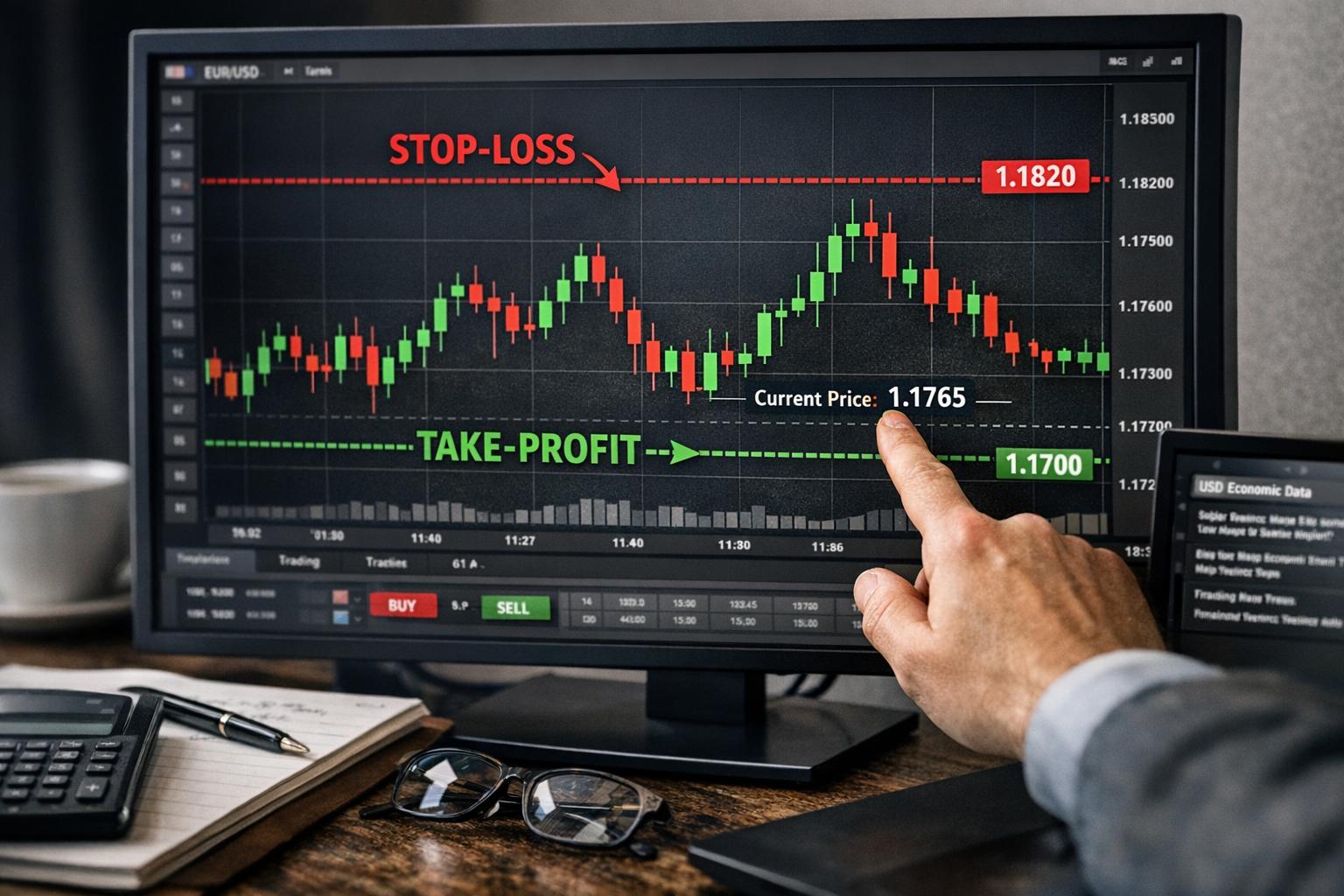
Understanding Stop-Loss and Take-Profit Levels
In the world of forex trading, effective risk management holds a position of paramount importance. One of the foundational elements of risk management involves setting stop-loss and take-profit levels. These mechanisms help traders efficiently manage their positions by determining specific price points for exiting trades, which is essential for minimizing potential losses and securing profits.
Risk management is not a supplementary aspect of trading; it forms the structural basis of long-term participation in the currency markets. Forex markets operate twenty-four hours a day during weekdays and are influenced by macroeconomic developments, geopolitical events, interest rate decisions, and liquidity conditions. Because prices can fluctuate rapidly, traders must define their exit conditions in advance. Stop-loss and take-profit orders provide that structure, allowing traders to establish parameters before market volatility alters decision-making.
What is a Stop-Loss Order?
A stop-loss order serves as a predefined price threshold at which a trader exits a losing trade. This order is crucial because its primary function is to limit the trader’s potential loss. When the market price reaches the stop-loss level, the trading platform is programmed to automatically close the trade. This intervention prevents further losses and is an essential tool for maintaining a sustainable trading portfolio.
A stop-loss can be placed in different ways depending on the trading strategy. For a long position, the stop-loss is typically placed below the entry price. For a short position, it is placed above the entry price. The location of the stop-loss should be determined by analytical reasoning rather than arbitrary point distances. For instance, placing a stop just beyond a support level when buying can reflect the logic that if the support fails, the trade premise is invalidated.
Stop-loss orders are also important because they define risk in measurable terms. By setting a stop-loss, traders can calculate exactly how much capital is exposed on a trade. For example, if a trader buys one standard lot of EUR/USD and sets a stop-loss 50 pips away, the potential loss can be computed based on pip value. This transparency allows traders to control risk as a percentage of their overall account balance.
Another dimension of stop-loss use involves market gaps and slippage. In highly volatile markets, the execution price might differ slightly from the requested stop level. While this cannot always be prevented, the existence of a stop-loss order still substantially reduces the probability of catastrophic losses compared to leaving a position unprotected.
What is a Take-Profit Order?
Conversely, a take-profit order is designed to close a trade when the market price hits a predetermined level of profit. This mechanism allows traders to lock in profits, thereby exiting the market before any unwanted reversals occur. In setting a take-profit order, traders should align the level with realistic profit projections, supported by comprehensive market analysis.
The take-profit order formalizes the exit strategy for successful trades. Without a predetermined target, traders may hold positions indefinitely, exposing themselves to reversals that erode gains. Markets often move in waves, and retracements are common. By defining an exit point in advance, traders avoid the uncertainty of deciding in real time when sufficient profit has been achieved.
Take-profit placement frequently corresponds with technical levels such as resistance in a long trade or support in a short trade. It may also align with measured price targets derived from chart patterns, Fibonacci projections, or volatility-based indicators. The essential principle is that the take-profit should reflect a rational expectation of price movement rather than an arbitrary ambition.
In some strategies, traders scale out of positions by setting multiple take-profit levels. For example, they may close a portion of the position at the first resistance level and allow the remainder to run toward a more distant objective. This approach balances the goal of securing partial profit with the opportunity to capture extended trends.
The Strategic Role of Exit Planning
Stop-loss and take-profit orders should be understood as complementary tools. Together, they define the boundaries of a trade. Before entering a position, a trader should be able to answer two questions: at what price is the trade idea proven incorrect, and at what price is the objective achieved? These answers shape the stop-loss and take-profit levels, respectively.
Defining exits before entry supports consistency. It prevents dynamic reinterpretation of market data to justify staying in a trade that no longer aligns with the original thesis. Structured exit planning also supports performance evaluation. Traders can review historical trades and assess whether stop placement and target selection were logically consistent with observed market behavior.
Calculating Stop-Loss and Take-Profit Levels
Establishing these levels is not a matter of guesswork; it demands careful deliberation and analysis of several key factors:
Market Analysis
The first step in defining stop-loss and take-profit levels involves a thorough market analysis. Traders must evaluate technical indicators such as moving averages, support and resistance levels, and chart patterns. Resources, including specialized software tools and platforms like TradingView, are invaluable in facilitating this analysis routine.
Technical analysis provides measurable reference points. Support and resistance zones reflect areas where price has historically reacted. Moving averages can help identify prevailing trends and dynamic support or resistance. Chart patterns such as head and shoulders formations, triangles, and flags can yield projected price targets by measuring structural components of the pattern.
Beyond technical tools, fundamental analysis also plays a role. Interest rate decisions, inflation reports, employment data, and central bank statements can alter currency valuations significantly. During periods surrounding major economic announcements, traders may choose to widen stop-loss levels or reduce position size to accommodate increased volatility.
Timeframe analysis is also relevant. A stop-loss derived from a daily chart structure will usually be larger than one based on a fifteen-minute chart. Traders should align exit levels with the timeframe that defines their strategy. Inconsistencies between entry timeframe and stop placement can distort risk calculations.
Risk-Reward Ratio
Another critical consideration is the risk-reward ratio, which weighs the potential reward against the potential risk. A commonly adopted benchmark among traders is a 2:1 ratio, implying that the potential profit is twice the anticipated loss. This ratio helps ensure a favorable balance between risk exposure and reward potential.
The risk-reward ratio is calculated by dividing the distance from entry to take-profit by the distance from entry to stop-loss. For instance, if a trader risks 40 pips with a potential gain of 80 pips, the ratio is 2:1. Maintaining ratios greater than 1:1 can allow traders to remain profitable even if less than half of their trades succeed.
However, the appropriate ratio depends on strategy characteristics. Scalping strategies may operate with lower ratios but higher win rates, while trend-following systems may involve wider stops and larger targets. The essential requirement is internal consistency: the stop-loss and take-profit must complement the statistical profile of the trading system.
Risk-reward evaluation should also incorporate win probability. A trade offering a 3:1 reward-to-risk ratio may appear favorable, but if the probability of success is very low, the expected value may not justify the trade. Integrating historical backtesting or forward-testing data can provide insight into realistic performance expectations.
Price Volatility
Price volatility is a significant factor in calculating these levels. For currency pairs exhibiting high volatility, a wider berth for stop-loss and take-profit levels may be necessary to accommodate larger price swings. Conversely, less volatile pairs may allow for narrower levels without excessive risk of triggering orders unintentionally.
Indicators such as the Average True Range (ATR) can quantify volatility. By measuring the average range over a specified period, traders can adjust stop-loss distances proportionally. For example, placing a stop at a multiple of the ATR helps ensure that the position has room to breathe within normal price fluctuations.
Market sessions also affect volatility. The overlap between major trading sessions, such as London and New York, often produces increased activity. Stop-loss and take-profit levels may need contextual adjustment depending on when the trade is initiated.
Position Sizing and Capital Allocation
Stop-loss placement directly influences position size. After determining the acceptable percentage of account equity to risk—many traders reference one to two percent—the lot size can be calculated based on the stop distance. A wider stop requires a smaller position size to maintain constant risk exposure.
For example, if a trader is willing to risk 1% of a $10,000 account, the maximum permissible loss is $100. If the stop-loss distance equates to $5 per pip, the stop should be positioned 20 pips away. If the required technical stop is 40 pips away, the position size must be reduced accordingly to maintain the $100 cap. This integration of stop placement and lot calculation supports disciplined capital management.
Implementing Stop-Loss and Take-Profit Levels
Once traders have determined the appropriate levels, the next step is to implement them in their trading platform. The majority of trading platforms offer options to set these levels both at the inception of a trade and through modifications to ongoing trades.
When placing a new order, traders can typically enter stop-loss and take-profit values directly into the order ticket. Alternatively, they may add them after execution by modifying the open position. Immediate placement is generally preferable because it ensures that protection is active from the outset.
Trading Platforms
Forex trading platforms, such as MetaTrader 4 or MetaTrader 5, include a suite of tools for setting stop-loss and take-profit levels with precision. Traders should explore the multitude of features these platforms offer to maximize the benefits of stop-loss and take-profit orders.
These platforms allow graphical adjustment of orders directly on charts. Traders can drag stop-loss and take-profit lines to visually align them with support, resistance, or indicator levels. This functionality reduces input error and supports accuracy. Additionally, advanced order types such as trailing stops can automatically adjust the stop-loss as the market moves in favor of the trade.
Algorithmic traders can also program stop-loss and take-profit logic into automated strategies. This ensures consistent application of rules without discretionary deviation. However, thorough testing is required to confirm that the programmed parameters perform reliably under varied market conditions.
Advanced Stop-Loss Techniques
Beyond static stop-loss placement, traders may apply dynamic approaches. A trailing stop moves incrementally as price advances in a favorable direction. If the market reverses by a specified distance, the position is closed. This method allows profit protection while permitting participation in extended trends.
Another method involves break-even stops. After the trade moves a certain distance in profit, the stop-loss is shifted to the entry price. This eliminates initial risk while keeping the trade active. However, premature movement to break-even can result in frequent early exits, so criteria should be clearly defined.
Time-based stops represent a less common but structured method. If a trade fails to progress within a predetermined timeframe, the position is closed regardless of price. This approach recognizes opportunity cost and capital efficiency.
Best Practices
To optimize the effectiveness of stop-loss and take-profit strategies, traders should adhere to the following best practices:
Adjust Levels Accordingly
Markets are dynamic and continuously evolving. Hence, it is essential to remain flexible and willing to adjust stop-loss and take-profit levels in response to new market data. Responding adeptly to changing market conditions can significantly enhance trading strategies and outcomes.
Adjustments should be based on objective evidence rather than reaction. For example, if a new support level forms as price trends higher, raising the stop-loss below that level may align with updated structure. In contrast, widening a stop to avoid realization of a loss generally contradicts disciplined risk control.
Avoid Emotional Trading
Traders are encouraged to faithfully adhere to their predetermined stop-loss and take-profit levels. The temptation to change these levels based on emotional reactions to market movements should be resisted, as such behavior is typically detrimental. Consistency is the cornerstone of successful trading, fostering a disciplined approach to managing trades.
A structured trading plan can reinforce adherence. By documenting entry rationale, stop placement logic, and target justification, traders create a measurable framework. Post-trade review can then evaluate whether execution aligned with planning.
Common Mistakes in Setting Exit Levels
Several recurring errors reduce the effectiveness of stop-loss and take-profit orders. Placing stops too close to entry without reference to market structure can result in frequent minor losses due to normal noise. Conversely, setting excessively wide stops without adjusting position size increases exposure disproportionately.
Another common issue is unrealistic profit targeting. Targets placed far beyond probable price movement often remain unfilled, leading traders to close positions manually with smaller gains after momentum fades. Aligning targets with observable volatility and structural resistance improves practical outcomes.
Failure to account for transaction costs is also relevant. Spreads and commissions affect net profitability and should be incorporated into risk-reward calculations, particularly for short-term strategies.
Conclusion
Implementing and adhering to carefully calculated stop-loss and take-profit levels empowers forex traders to manage risks effectively while also securing potential profits. These tools define the structural boundaries of each trade, translating analysis into measurable exposure. Through disciplined application, alignment with market structure, appropriate position sizing, and consistent evaluation, stop-loss and take-profit orders form the operational backbone of responsible forex trading. This methodical approach cultivates structured and strategic trading practices, which are essential for long-term participation in the global currency markets.
This article was last updated on: March 28, 2026