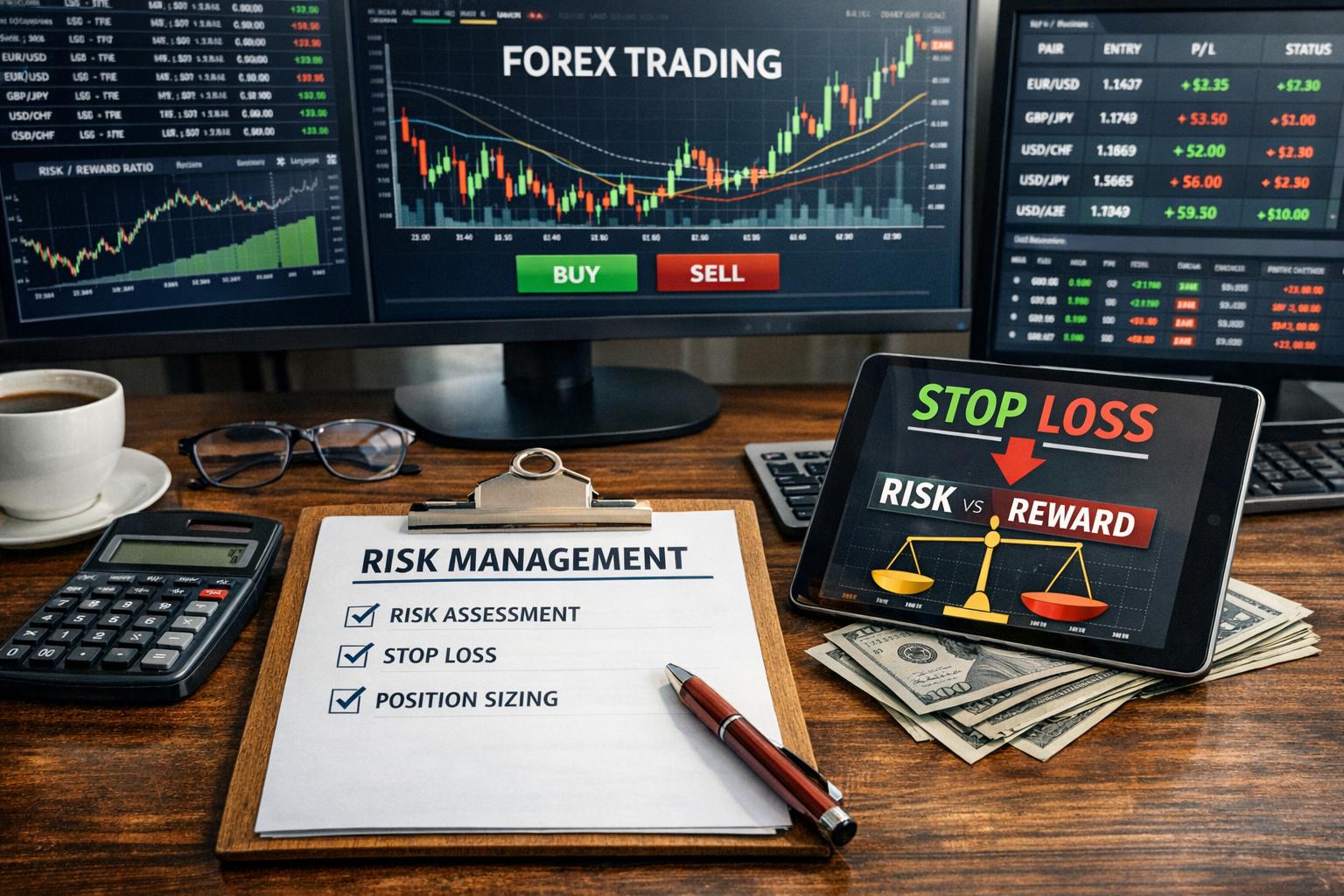
The Role of Risk Management in Forex Day Trading
Forex day trading is an intriguing and potentially profitable endeavor, but it also comes with inherent risks. Understanding and implementing effective risk management strategies is crucial for traders who wish to protect their capital and increase their opportunities for long-term success. While many new participants focus primarily on entry signals and market timing, experienced traders recognize that risk management is the foundation upon which all sustainable trading performance is built. In day trading, where multiple positions may be opened and closed within a single session, disciplined risk control becomes even more important due to the speed and frequency of decision-making.
The foreign exchange market operates twenty-four hours a day during the trading week, reacts rapidly to economic releases, and frequently experiences volatility spikes. These characteristics create opportunities, but they also expose traders to sudden and substantial price movements. Without clearly defined parameters governing trade size, acceptable loss, and exposure limits, even a short series of unfavorable outcomes can significantly impair an account. For this reason, risk management is not a secondary consideration; it is a structural component of every trade plan.
Understanding Risk Management
Risk management in forex trading involves identifying, analyzing, and mitigating financial risks to ensure that a trader’s capital is protected. It encompasses a set of strategies that help traders limit losses and optimize their trading portfolios. The primary goal is to safeguard your trading account from excessive losses.
In practical terms, risk management requires a trader to define in advance how much capital can be exposed on a single trade, a single day, or across correlated positions. It also involves evaluating the probability of different market outcomes and preparing responses before entering the market. This systematic preparation helps remove impulsive reactions and replaces them with structured procedures.
Risk in forex day trading can arise from several sources. Price volatility is the most apparent, but other elements such as leverage, liquidity conditions, economic news releases, geopolitical events, and technical disruptions also play a role. A comprehensive approach to risk management accounts for each of these variables and incorporates appropriate safeguards.
Components of Risk Management
Effective risk management includes several key components:
1. Position Sizing: This involves determining the appropriate size of a trade relative to the total capital. Proper position sizing ensures that no single trade can significantly impact your account balance. Traders often employ techniques such as the fixed dollar model or the percent risk model, where a certain percentage of the total capital is risked. This component is vital because it directly affects how resilient a trader’s account is to a series of losing trades.
Position sizing links risk directly to account equity. For example, a trader who limits exposure to one percent of total capital per trade can sustain a sequence of unfavorable trades without catastrophic damage. In contrast, risking ten percent per trade exposes the account to rapid depletion. Over time, consistency in position sizing creates stability in performance metrics and allows statistical advantages in a strategy to materialize. Adjusting position size in response to changes in account balance also ensures that risk remains proportional as the account grows or contracts.
2. Stop-Loss Orders: Stop-loss orders are predefined price levels at which a trade is automatically closed to prevent further losses. Setting stop-loss orders helps in maintaining discipline and protecting capital. This tool is an emotional shield since it allows the trader to set the maximum loss they are willing to accept and stick to it, avoiding the trap of hoping for a market reversal that may never come. Moreover, it is important to adjust stop-loss orders based on market volatility and individual risk tolerance.
Stop-loss placement should be derived from market structure rather than arbitrary distance. Traders often use technical levels such as support and resistance, recent swing highs or lows, or volatility indicators to determine where a trade thesis becomes invalid. A poorly placed stop-loss can result in premature exits, while an excessively wide stop increases the capital at risk. In day trading, where price movements can be rapid, automated stop execution reduces reliance on manual intervention and maintains adherence to pre-set risk parameters.
3. Diversification: Diversification entails spreading investments across different currency pairs and trading strategies to reduce exposure to any one particular market movement. By doing so, traders can mitigate the risk that comes with market-specific factors affecting a singular currency pair. This approach also encourages the exploration of various trading strategies, which can provide additional profit opportunities and more stable returns over time.
However, diversification in forex trading must account for correlation. Certain currency pairs move in similar directions due to shared economic drivers. Opening positions in multiple correlated pairs may concentrate rather than reduce risk. Effective diversification evaluates the relationships between positions and considers the broader macroeconomic landscape influencing each currency.
4. Risk-Reward Ratio: This ratio compares the potential reward of a trade to the risk taken. A common rule is to aim for a risk-reward ratio of at least 1:2, meaning the potential gain should be at least twice the potential loss. This ensures that even with a series of losing trades, a trader can still be profitable with just a few winning trades. The calculation of risk-reward ratios requires careful market analysis and consideration of current market conditions.
The risk-reward ratio directly influences long-term expectancy, which measures the average amount a trader can expect to gain or lose per trade over time. A system with a modest win rate can remain profitable if the average winning trade significantly exceeds the average losing trade. Therefore, evaluating trade setups through a risk-reward lens before entry promotes selectivity and discourages low-quality trades.
Additional Dimensions of Risk in Forex Day Trading
Beyond the core components, several additional factors shape the risk environment in forex day trading. Leverage is among the most significant. Forex brokers often offer high leverage ratios, allowing traders to control large positions with relatively small capital. While leverage can amplify gains, it equally magnifies losses. Prudent risk management integrates leverage into position sizing calculations to ensure that effective exposure remains within acceptable limits.
Market volatility also demands attention. Currency prices respond quickly to macroeconomic data such as employment reports, inflation statistics, and central bank announcements. During these periods, spreads may widen and price slippage may occur. A risk-aware trader considers whether to reduce position sizes, widen stops temporarily, or avoid trading around scheduled high-impact events.
Liquidity risk arises when market depth is insufficient to execute orders at expected prices. Although major currency pairs typically offer strong liquidity, conditions can shift during off-peak hours or unexpected crises. Incorporating conservative assumptions about execution quality into planning helps prevent underestimation of potential losses.
Operational risk includes technical failures, connectivity disruptions, or platform malfunctions. Establishing contingency plans, such as access to alternative devices or broker contact procedures, is a practical extension of risk management. While these issues may not occur frequently, preparedness reduces vulnerability.
Importance of Risk Management
Implementing risk management strategies is critical to achieving consistent outcomes in forex day trading. Without such measures, even a small adverse market movement can lead to significant losses. Here are some reasons why risk management is essential:
Capital Preservation: The primary objective of risk management is to preserve trading capital. By limiting losses, traders can stay in the game and continue to trade another day. Preservation of capital should always take precedence over chasing after profits because it provides the lifeline needed to survive turbulent market conditions and to take advantage of potential opportunities that may arise in the future.
Capital preservation also supports the mathematical principle of recovery. Large percentage losses require disproportionately large gains to return to the original account level. For instance, a fifty percent loss requires a one hundred percent gain to recover. By avoiding severe drawdowns, traders maintain flexibility and reduce the pressure associated with attempting recovery under strained conditions.
Psychological Stability: Effective risk management reduces stress and emotional decision-making. Knowing that you have safeguards in place allows traders to focus on their strategies without fear of losing their entire account. Trading psychology is often an underestimated aspect of trading success. By integrating risk management strategies, traders can maintain a clear mind and make decisions based on rational analysis. This stability allows them to adhere to their trading plan and avoid impulsive decisions driven by market noise or temporary price fluctuations.
Emotional responses such as fear and overconfidence frequently arise after significant losses or gains. Predetermined limits on daily or weekly losses can serve as circuit breakers, prompting traders to step back and reassess rather than continue trading under heightened emotional states.
Long-term Success: Consistently successful traders are those who adopt sound risk management practices. By managing risk, traders can build their accounts over time and achieve sustainable profits. Successful trading is less about individual trades and more about the cumulative effect of disciplined risk management over the long term. Through consistent application of these techniques, traders gain experience, confidence, and the ability to handle market volatility more effectively.
Long-term viability in day trading depends on maintaining a statistical edge and controlling variance. Risk management reduces the amplitude of equity swings, making performance more predictable and measurable. This structured approach enables objective evaluation and continuous refinement of trading systems.
Strategies for Improving Risk Management
There are several strategies that traders can employ to enhance their risk management:
Analyzing Historical Performance: Reviewing past trades to understand what strategies were successful and which failed can help traders refine their risk management techniques. By identifying patterns and adjusting strategies accordingly, traders can optimize their risk management methods to better suit their trading style and market conditions.
Maintaining a detailed trading journal supports this review process. Recorded data may include entry and exit points, risk-reward calculations, market context, and emotional state during execution. Over time, this documentation reveals behavioral tendencies and structural weaknesses that can be addressed through parameter adjustments.
Leveraging Technology: Utilizing trading platforms and risk management tools that offer features like automated stop-loss, trailing stops, and alerts can aid in executing risk management strategies more efficiently. Technology can remove human error and emotion from the equation, ensuring that risk management strategies are applied consistently across all trades.
Advanced analytics tools can also calculate metrics such as maximum drawdown, average risk per trade, and expectancy. These objective measurements help traders evaluate whether current exposure levels align with their tolerance and financial goals.
Continuous Learning: The forex market is dynamic, and risk management strategies need to evolve to accommodate changing market conditions. Traders should constantly seek to update their knowledge about market trends, new risk management tools, and techniques that can enhance their overall trading strategy.
Continuous learning also involves understanding regulatory guidance and industry standards. Resources provided by financial institutions such as FINRA and FCA offer educational material regarding market conduct, leverage restrictions, and investor protection frameworks. Familiarity with these principles supports informed decision-making and reinforces responsible trading practices.
Conclusion
Forex day trading presents significant opportunities but also substantial risks. Risk management is an indispensable part of trading that cannot be overlooked. Traders should develop a comprehensive risk management plan tailored to their individual needs and stick to it. By prioritizing structured exposure limits, disciplined position sizing, thoughtful stop placement, and ongoing performance analysis, traders enhance their ability to operate consistently within a volatile environment.
Successful risk management is a blend of analytical structure and practical judgment. As traders deepen their understanding of risk control, they are more likely to navigate the forex market effectively, safeguarding their capital while capitalizing on the opportunities it offers. The discipline developed through consistent application of these principles provides a framework for sustainable participation in the global currency markets.
This article was last updated on: March 28, 2026