The Importance of Trading Journals in Forex Day Trading
In the intricate world of Forex day trading, maintaining a trading journal is often overlooked, yet it plays a vital role in enhancing a trader’s path to success. It isn’t a foolproof method to guarantee profits, but it serves as an essential tool for refining strategies and achieving long-term improvement. In this article, we’ll explore the significant benefits of keeping a trading journal and how it can aid in a trader’s journey of continuous enhancement.
Forex day trading operates in a fast-paced environment where price movements occur within minutes, sometimes seconds. Decision-making is often compressed into short timeframes, and multiple trades may be executed within a single session. In such conditions, memory alone is not a reliable source of analysis. A structured journal provides a written and visual record that allows traders to evaluate actions objectively rather than relying on recollection. Over time, this detailed documentation becomes a personalized database of experience.
Unlike automated performance reports generated by trading platforms, a trading journal captures not only numerical data but also context. It reflects the reasoning behind each decision, the trader’s expectations, and the conditions under which trades were placed. This additional depth transforms raw trading history into meaningful insight.
Understanding Trading Journals
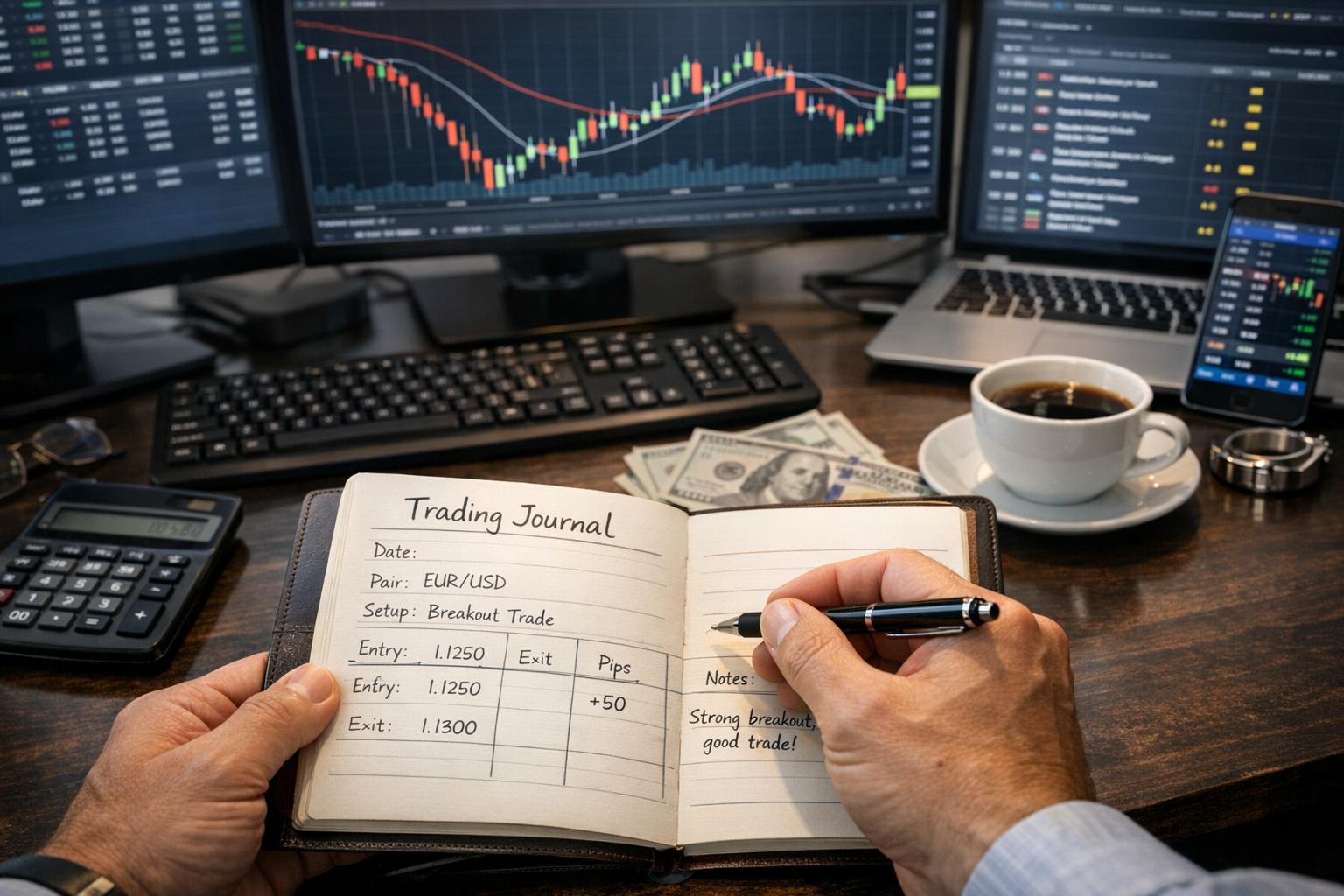
A trading journal is essentially a detailed record that a trader maintains, documenting each trade in an organized manner. Commonly included in the journal is information such as the time and date of the trade, the currency pairs traded, entry and exit points, position sizes, and most importantly, the rationale behind each trading decision. Some advanced trading journals may also incorporate screenshots of charts, notes on prevailing market conditions, and personal reflections to deepen the understanding of each trade. This approach is designed to promote a disciplined and data-oriented trading habit.
There are different formats a trading journal can take. Some traders prefer spreadsheets due to their flexibility and analytical capability. Others use specialized software that automatically imports trade data from brokers. Physical notebooks are also used, particularly by traders who value manual reflection. The medium itself is less important than the consistency and structure of the recorded information.
At its core, a trading journal answers several critical questions: Why was the trade taken? Was it aligned with the trading plan? What external factors influenced the decision? How was risk managed? By systematically addressing these questions after each trade, the trader builds a habit of structured thinking.
A comprehensive journal may include quantitative metrics such as risk-to-reward ratio, win rate, drawdown percentage, and average holding time. It may also record qualitative elements such as confidence level before entry or hesitation during execution. Together, these elements create a complete overview of performance that extends beyond profit and loss figures.
The Role of Data in Forex Day Trading
Forex markets generate significant amounts of data every trading day. Prices fluctuate in response to economic indicators, central bank policies, geopolitical developments, and market sentiment. Day traders focus on shorter timeframes, often analyzing one-minute to one-hour charts. In this context, small inefficiencies can accumulate rapidly.
A trading journal acts as a personal dataset. Instead of relying solely on external research or generalized strategies, traders can analyze their own behavioral and performance data. For example, a journal may reveal that trades placed during the London session consistently outperform those placed during quieter periods. Similarly, it may show that certain currency pairs align better with the trader’s preferred strategy.
Over weeks and months, this collected data enables evidence-based decision-making. Rather than modifying strategies based on isolated outcomes, traders can evaluate statistically significant samples of trades. This approach reduces guesswork and strengthens confidence in adjustments.
Benefits of Keeping a Trading Journal
One of the fundamental advantages of maintaining a trading journal is the ability to have a comprehensive view of past trading activities. Carefully documenting trades helps traders to identify patterns and avoid repeating mistakes that may not be apparent at first glance. This all-encompassing view is crucial for self-assessment and plays a significant role in enhancing future trading prowess.
Patterns in trading are not limited to chart formations. They include behavioral tendencies such as entering trades prematurely, exiting profitable positions too early, or increasing position size after a loss. Without written documentation, these tendencies may remain unnoticed. A journal provides clarity by presenting repeated behaviors in a visible format.
Additionally, a trading journal assists in evaluating the effectiveness of trading strategies. By regularly revisiting past trades, traders are equipped to determine which strategies are most successful under various market conditions. Such insights are invaluable for refining trading techniques and enabling well-informed decisions in future trades.
For example, a breakout strategy may perform well during high volatility news releases but poorly in ranging markets. By isolating trades based on market structure, the trader can determine where the edge truly exists. The journal becomes a testing ground for hypotheses, allowing systematic improvement rather than random modification.
Moreover, trading journals can play a crucial role in emotional management by helping traders record their emotions and thoughts during trades. Understanding and controlling emotions is vital for success in Forex trading, and by reflecting on how emotions influenced trading decisions, traders can work towards nurturing a more balanced and rational trading mindset.
Emotional responses such as fear, overconfidence, frustration, or impatience can directly influence execution quality. A journal entry noting hesitation before pulling the trigger or anxiety during drawdown highlights areas that may require psychological adjustment. Over time, the trader can compare emotional states with trade outcomes and work toward consistency.
Enhancing Accountability
Trading journals can significantly boost accountability among traders. This accountability is born from the routine practice of meticulously reviewing and analyzing trading activities. Such analysis inspires traders to remain committed to their trading plans and avoid impulsive decisions. In this way, a trading journal acts as a personal accountability partner, offering insights on whether or not a trader has adhered to their specified rules and strategies.
Day trading often occurs in isolation. Without colleagues or supervisors monitoring decisions, it becomes easy to deviate from established guidelines. A journal introduces structure. Knowing that every trade must be documented encourages more deliberate decision-making.
Accountability also extends to risk management. Recording the intended risk percentage for each trade and comparing it with actual execution can highlight inconsistencies. If a trader repeatedly exceeds predefined limits, the journal provides documented evidence. This documentation supports corrective measures and reinforces disciplined behavior.
Periodic reviews, whether weekly or monthly, strengthen accountability further. During these reviews, traders can calculate performance metrics, identify deviations from their plan, and establish measurable goals for the next period. This ongoing evaluation transforms trading into a structured process rather than a series of unrelated actions.
Facilitating Continuous Learning
The Forex market is in a constant state of flux, and the traders who thrive are those who are committed to continual learning and adaptation. A trading journal functions as a unique learning tool, helping traders identify gaps in their knowledge and areas for improvement. By meticulously reviewing past successes and failures, traders can adapt to market transformations and refine their skill sets.
Each trade contains a lesson, whether profitable or not. A winning trade may reveal that patience in waiting for confirmation improves results. A losing trade may demonstrate that entering against higher timeframe trends reduces probability. Documenting these lessons ensures they are not forgotten.
Over time, the journal becomes a repository of practical experience that complements theoretical knowledge. Market textbooks explain concepts such as support and resistance or moving average convergence. The journal demonstrates how these concepts were applied in real scenarios and what outcomes followed.
Continuous learning also involves identifying market conditions that reduce performance. If analysis reveals declining accuracy during periods of low liquidity, the trader can adjust schedule or strategy accordingly. Rather than attributing losses to randomness, the journal provides direction for adaptation.
Improving Strategy Development and Testing
Forex day traders frequently modify or refine strategies. Without documentation, changes may be introduced without proper evaluation. A journal allows traders to label trades according to specific setups. For instance, trades based on pullbacks, breakouts, or scalping patterns can be categorized and assessed independently.
By grouping similar trades, performance metrics such as average reward-to-risk ratio or win percentage become more meaningful. If one setup consistently underperforms, it can be adjusted or removed. Conversely, high-performing setups can receive greater focus. This structured testing process resembles scientific experimentation, with the journal serving as the laboratory notebook.
Backtesting and forward testing also benefit from journal integration. After historical testing suggests a potential edge, forward trades are recorded in real time. Comparing expected outcomes with actual results reveals whether the strategy translates effectively into live conditions.
Strengthening Risk Management Practices
Risk management remains one of the foundations of Forex day trading. Even strategies with moderate win rates can produce stable performance when risk is controlled effectively. A trading journal reinforces risk discipline by tracking metrics such as maximum drawdown, consecutive losses, and average risk exposure.
Documenting stop-loss placement and trade sizing decisions encourages consistency. If deviations occur, such as widening stops without strategic justification, the journal entry highlights the behavior. Recognizing patterns in risk deviation enables corrective measures before significant capital erosion occurs.
Risk-to-reward analysis becomes clearer with documentation. Traders can review whether they consistently maintain favorable ratios or whether emotional factors lead to premature exits. Over time, these observations contribute to more stable equity curves.
Developing Professional Trading Habits
Maintaining a trading journal promotes professionalism. Instead of approaching Forex day trading casually, the trader treats it as a structured business activity. Businesses track revenue, expenses, and operational processes. Similarly, traders track entries, exits, strategies, and outcomes.
This professional mindset encourages preparation before sessions and evaluation afterward. Pre-trade plans can be documented alongside post-trade analysis, creating a complete workflow. As habits become standardized, decision-making efficiency improves.
Professional habits also extend to time management. A journal may reveal that trading during specific hours yields higher efficiency, while extended screen time reduces focus. Adjustments can then be made to optimize productivity and concentration.
Implementing a Trading Journal Effectively
The effective creation and maintenance of a trading journal demand discipline and dedication. Traders should ensure their journal is thorough and updated promptly after each trading session to capture the freshest insights. Integrating new market insights and lessons into each entry is crucial to maximizing the value of the journal. Fortunately, there are various digital tools and platforms available to simplify this process, offering user-friendly ways to record trades and analyze data systematically. To explore useful platforms, you might consider visiting a trading journal platform.
Consistency is essential. Entries should follow a structured format so that data remains comparable. Standard fields might include setup type, timeframe, direction, risk percentage, outcome, and notes. Maintaining uniform categories simplifies later analysis.
Scheduling regular review sessions enhances effectiveness. Weekly summaries can focus on short-term adjustments, while monthly evaluations assess broader strategic direction. During these reviews, traders may calculate cumulative performance metrics or identify behavioral observations worth addressing.
It is also beneficial to separate objective data from subjective reflections. Numerical statistics provide measurable performance indicators, while written reflections capture thought processes. Together, they present a balanced view of trading development.
Privacy and organization should not be overlooked. Whether digital or physical, the journal should be securely stored and easily accessible. Clear labeling by date or strategy helps streamline retrieval when conducting long-term analysis.
Common Challenges and Practical Solutions
Despite its benefits, maintaining a trading journal presents challenges. Traders may neglect entries after losing sessions or during busy periods. To address this, allocating a fixed time after each trading session for documentation can establish routine. Even brief but structured notes are preferable to incomplete records.
Another challenge involves excessive detail. Recording unnecessary information can make the journal difficult to manage. Focusing on data that directly influences performance ensures clarity. Over time, traders can adjust the level of detail based on what proves most useful.
Technological difficulties may also arise when integrating journal software with trading platforms. Selecting reliable tools and periodically backing up data can mitigate such issues. The goal is to create a sustainable system rather than an overly complex one.
Long-Term Impact on Trading Performance
The value of a trading journal becomes increasingly evident over extended periods. Short-term results in Forex day trading can fluctuate due to market variability. However, long-term records reveal whether the trader maintains a statistical edge.
By tracking months or years of activity, patterns in growth, stagnation, or decline emerge. These patterns inform strategic decisions, such as scaling position size or revising a trading plan. Without long-term documentation, such evaluations rely on partial memory.
Furthermore, accumulated records provide perspective during challenging periods. Reviewing past recoveries from drawdowns may reinforce adherence to proven systems. The journal thus acts not only as a technical tool but also as a stabilizing reference.
Conclusion
In conclusion, trading journals are an invaluable resource for Forex day traders who seek lasting success. They go beyond being mere record-keeping tools; they function as educational aids that bolster accountability and promote learning. By dedicating the necessary time and effort to maintaining a comprehensive trading journal, traders can derive valuable insights, refine their strategies, and ultimately enhance their trading performance over time. As such, the commitment to keeping a well-maintained trading journal is a strategic investment in a trader’s long-term success.
This article was last updated on: March 28, 2026