2026-03-27
Understanding the Impact of Major Economic Reports
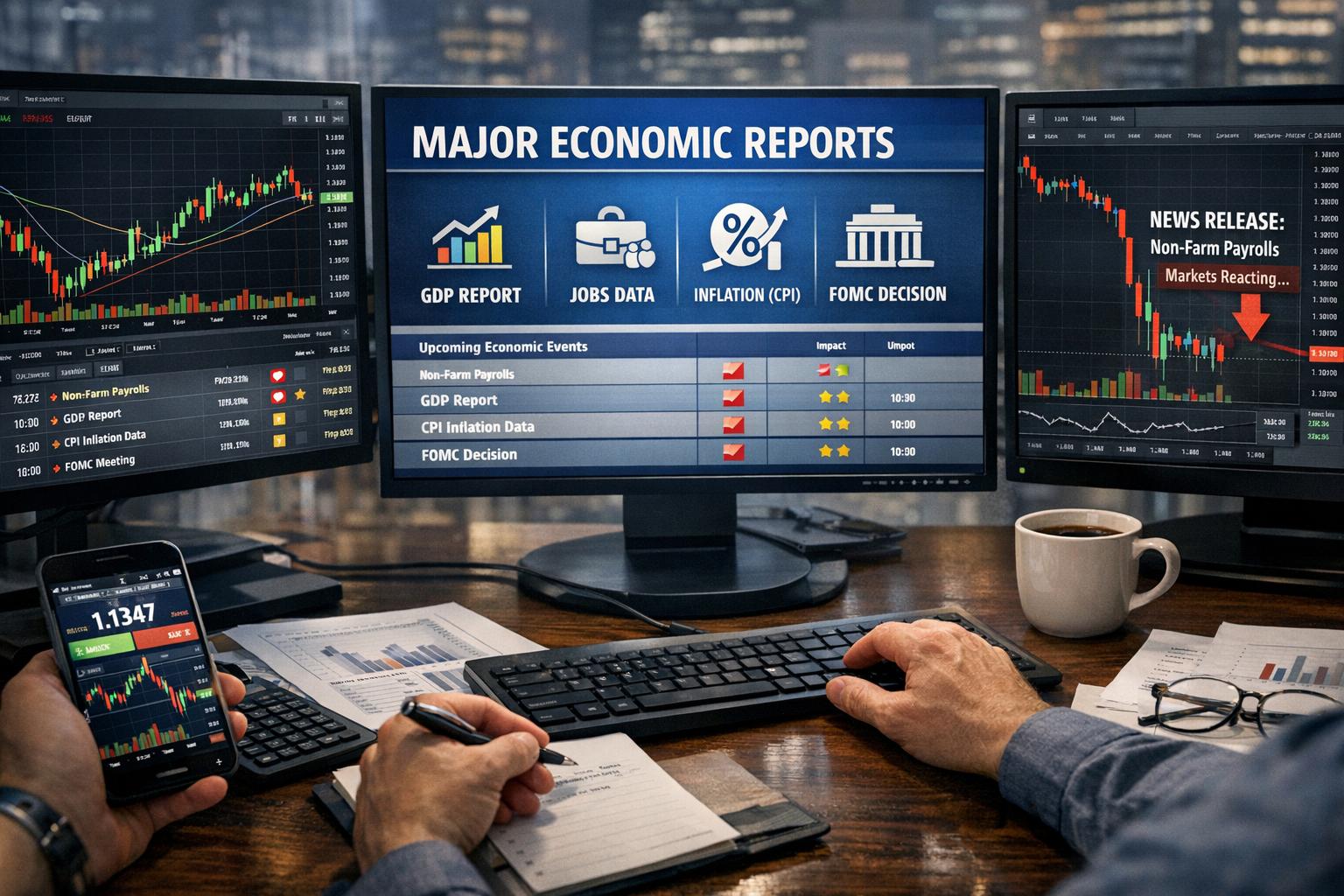
When trading in the Forex market, understanding the influence of major economic reports is essential. These reports encompass a variety of economic indicators, including unemployment rates, Gross Domestic Product (GDP), inflation statistics, retail sales figures, interest rate decisions, and manufacturing data. Such information has the power to induce significant volatility in currency values, making it crucial for traders to stay informed about when these reports are scheduled for release. By knowing the exact dates and times, traders can better forecast potential market dynamics and prepare themselves accordingly.
Major economic reports represent structured assessments of a country’s economic performance. Governments, central banks, and statistical agencies compile these reports using established methodologies that aim to measure changes in productivity, employment, price stability, and consumer behavior. Because currencies reflect the relative strength of national economies, any new piece of macroeconomic information can trigger adjustments in valuation. Forex markets operate on expectations as much as on actual data, which means that even minor deviations from forecasts can influence price movement.
The relationship between economic data and currency valuation is grounded in fundamental analysis. For example, when GDP growth exceeds expectations, it often signals expanding economic activity. Investors may interpret this as a sign of higher future interest rates or improved corporate profitability, leading to increased demand for that country’s currency. Conversely, weaker-than-anticipated data may reduce investor confidence and trigger depreciation. Understanding how these cause-and-effect relationships unfold allows traders to contextualize price swings in a systematic manner rather than perceiving them as random fluctuations.
Interest rate decisions are particularly influential. Central banks use interest rates to manage inflation and economic growth. If a central bank signals that it will raise rates to control inflation, foreign capital may flow into that country in search of higher returns, driving currency appreciation. On the other hand, rate cuts can weaken a currency if they signal slower growth or accommodative monetary policy. Therefore, reports that influence expectations about interest rate paths tend to amplify market reactions.
The timing of these reports also contributes to their impact. Major announcements are typically released at scheduled times, often before or shortly after major financial markets open. This concentration of information release creates periods of temporarily reduced liquidity followed by rapid price adjustment. During these intervals, spreads may widen, and execution speeds can be affected. Understanding these structural characteristics of the Forex market is as important as understanding the data itself.
Preparing for Major Economic Reports
Prior to the release of any pivotal economic report, traders are advised to engage in comprehensive preparation. This preparation extends beyond merely noting the event on a calendar. It involves reviewing historical trends, assessing consensus expectations, and analyzing how similar reports affected the market in the past. By comparing previous outcomes with current projections, traders can build a framework for interpreting possible scenarios.
Market expectations are typically formed through surveys of economists and financial institutions. These expectations are often summarized as “consensus forecasts.” The Forex market tends to price in these forecasts ahead of the official release. As a result, the actual reaction frequently depends more on the deviation from consensus than on the raw number itself. If the market expects inflation to rise by 2 percent and the report confirms precisely that level, the currency reaction may be limited because the information was already anticipated.
Preparation also includes technical analysis. Although economic reports are fundamental drivers, technical indicators help traders identify key support and resistance levels that may serve as reference points during volatile periods. For instance, if a key employment report is approaching and a currency pair is trading near a historically significant resistance level, traders may anticipate that a stronger-than-expected result could trigger a breakout. Aligning fundamental expectations with technical structures enhances strategic planning.
Scenario analysis plays a central role in preparation. Traders often outline several potential outcomes—strong data, neutral data, and weak data—and consider the probable market reaction to each. This approach reduces the likelihood of impulsive decisions once the report is released. Instead of reacting emotionally to the headline number, traders operate within a predefined analytical structure. Such discipline contributes to consistent performance over time.
Utilizing Economic Calendars
One of the indispensable tools for traders is the economic calendar. This resource lists the dates and times of upcoming economic reports. In addition, it offers critical information such as previous data, forecasts, and the predicted degree of market impact. Regularly consulting an economic calendar enables traders to devise strategies that align with key economic events, thus preventing unwanted surprises from market turbulence.
Economic calendars typically classify events according to expected volatility levels. High-impact events include central bank rate decisions, GDP releases, and employment statistics such as nonfarm payrolls. Medium-impact events may involve consumer confidence or housing data. Lower-impact events can still influence markets but usually produce more moderate price changes. Recognizing these categories helps traders allocate attention proportionately and avoid overreacting to minor reports.
In addition to listing scheduled announcements, economic calendars provide historical comparisons. Viewing past figures alongside forecasts allows traders to identify trends. For example, if inflation has consistently exceeded expectations over several months, traders might anticipate a stronger possibility of central bank intervention. This contextual interpretation transforms raw data into strategic insight.
It is also important to consider time zones and market sessions. Forex trading is continuous across major financial centers, including London, New York, and Tokyo. An economic report released during the overlap of major sessions may generate higher liquidity and sharper moves compared to a release during quieter periods. By integrating calendar information with session analysis, traders can better understand the potential scope of volatility.
Strategies for Trading During Economic Reports
Navigating the Forex market during the release of economic reports demands a strategic mindset to control risk and enhance profit potential. Traders must pay attention to several key components when shaping their trading strategies under such circumstances. These components include market sentiment assessment, volatility expectations, execution planning, and risk control mechanisms.
Different traders adopt different approaches to trading around news events. Some focus on short-term opportunities created by immediate price momentum, while others prefer to wait for confirmation before entering positions aligned with the broader trend. Neither approach is inherently superior; effectiveness depends on experience, risk tolerance, and trading objectives.
Analyzing Market Sentiment
Understanding market sentiment forms the backbone of effective Forex trading. Before a report is officially released, traders can gauge sentiment through news analysis, institutional research notes, and price behavior leading up to the event. If a currency has been appreciating steadily before a GDP release, the market may already anticipate strong results. In such cases, even positive data might trigger limited upside because expectations were elevated.
A disparity between actual data and forecasts can lead to major shifts in currency values. For instance, if employment growth significantly surpasses projections, short sellers may rush to close positions, amplifying upward momentum. Conversely, if data disappoints sharply, long positions may unwind rapidly. By evaluating positioning indicators and price action prior to the release, traders gain insight into how crowded a particular trade direction may be.
Forward guidance from central banks also influences sentiment. Statements accompanying rate decisions sometimes provide more insight than the rate change itself. Subtle variations in language, inflation outlook, or growth projections can reshape expectations about future monetary policy. Therefore, effective sentiment analysis requires attention not only to numerical data but also to qualitative commentary.
Implementing Risk Management
The release of economic reports is often accompanied by heightened volatility. As a result, robust risk management is essential. Key aspects of this management include setting suitable stop-loss orders, adjusting position sizes, and evaluating leverage exposure. Volatility can cause rapid price swings that exceed normal daily ranges, increasing the probability of slippage or unexpected losses.
Stop-loss placement during high-impact news events requires careful calibration. Placing stops too close to the entry point may result in premature exit due to temporary price spikes. Placing them too far may expose the account to excessive drawdown. A balanced approach involves reviewing historical volatility metrics to estimate a reasonable range for potential movement.
Leverage requires particular caution. While leverage can amplify profits, it equally magnifies losses. During economic announcements, price gaps and widened spreads can intensify risk beyond standard projections. Many experienced traders reduce leverage ahead of major releases to maintain capital preservation. Protecting trading capital ensures the ability to participate in future opportunities, which is a core objective of sustainable Forex trading.
Another dimension of risk management involves correlation awareness. Certain currency pairs are closely related due to shared economic factors or geographic proximity. Opening multiple positions that rely on the same economic outcome may inadvertently increase total exposure. Evaluating portfolio-level risk rather than single-trade risk provides a more comprehensive safeguard.
Deciding to Trade or Wait
The decision on whether to trade during a period of high volatility or to wait is a strategic one. Some traders may opt to pause and observe the initial market response before committing to any trades. By doing so, they can avoid abrupt price spikes that commonly follow the release of an economic report. This approach prioritizes confirmation over immediacy.
Waiting for clarity can allow the market to establish a directional bias. Often, the initial reaction to a report is followed by a partial retracement as liquidity returns and traders reassess the broader implications. Entering after this stabilization phase can reduce the influence of short-term noise. However, this method may also limit the potential to capture the full extent of the initial move.
Alternatively, some traders specialize in trading breakouts triggered by high-impact news. They place pending orders above and below key technical levels prior to the announcement, aiming to capture momentum regardless of direction. This technique requires rigorous risk parameters and reliable execution conditions. Selecting the appropriate approach depends on familiarity with market behavior and individual trading discipline.
Post-Report Market Analysis
After an economic report is made public, assessing the market’s response becomes essential. Traders must compare the newly released data against their initial forecasts and take note of how the market has readjusted. This form of analysis offers valuable insights that can guide future trading activities and assist in refining strategic approaches.
Post-report evaluation involves examining not only the headline figure but also underlying components. For example, an employment report may show strong job creation but weak wage growth. Such details can alter the long-term implications for inflation and monetary policy. By dissecting these nuances, traders avoid oversimplified interpretations.
Price reaction analysis is equally important. Sometimes the market reaction may appear inconsistent with the data itself. A currency might decline despite strong economic results if investors had already anticipated even stronger outcomes. Understanding this phenomenon reinforces the principle that expectations drive much of Forex pricing. Traders who systematically review these discrepancies build a deeper awareness of market psychology.
Learning from Experience
Each instance of economic report release serves as an educational opportunity. Evaluating past trades in light of market reactions allows traders to continually enhance their strategic methods. Maintaining a detailed trading journal is a practical way to support this learning process. By recording expectations, entry points, exit decisions, and outcomes, traders can identify recurring strengths and weaknesses.
Over time, patterns emerge. A trader may discover that certain types of reports consistently produce unpredictable volatility, suggesting a preference to avoid trading them directly. Alternatively, some reports may align well with a trader’s strategy, offering repeatable opportunities. Continuous evaluation transforms experience into structured knowledge.
Learning also involves reassessing assumptions. Economic relationships are not static; they evolve with changing global conditions. For instance, inflation dynamics during periods of supply chain disruption differ from those in stable environments. Adapting analytical frameworks to reflect current realities ensures that trading strategies remain relevant.
Staying Informed
Maintaining awareness of global economic trends and news developments is another critical element for traders. Tapping into reliable financial news outlets and expert analyses enables traders to achieve a more comprehensive perspective on the economic landscape. Staying consistently informed provides the necessary foundation for adapting trading approaches dynamically in response to evolving conditions.
Global interconnectivity means that economic developments in one region can influence currencies elsewhere. Trade relationships, geopolitical factors, and cross-border investment flows all contribute to exchange rate movements. Therefore, monitoring international developments alongside domestic indicators broadens analytical depth.
Central bank communications deserve particular attention. Speeches, meeting minutes, and policy reports often clarify the rationale behind monetary decisions. By integrating these qualitative insights with quantitative data, traders gain a more rounded understanding of policy direction. This comprehensive awareness reduces reliance on isolated data points and promotes balanced judgment.
By keeping abreast of economic announcements and ensuring your trading methodology is both informed and adaptable, you can better navigate the challenges of the Forex market environment. As a trader, the key lies in consistently updating your strategies to reflect the current economic climate, thus ensuring readiness and resilience against market fluctuations that may occur due to economic report releases. Sustained success in Forex trading depends not on predicting every data outcome but on managing risk prudently, analyzing information methodically, and responding to economic developments with structured discipline.
This article was last updated on: March 28, 2026